
Capital Glazing guide
Skylight Glass Replacement Cost in Sacramento (2026)
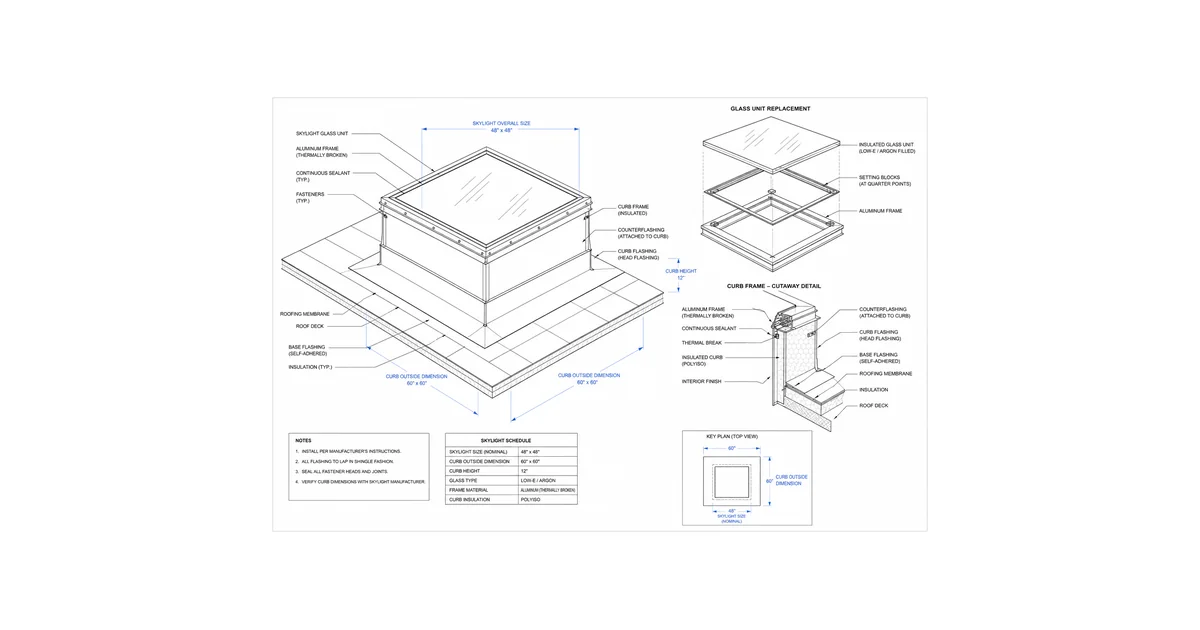
If your skylight is cracked or hazed over, the question is whether you swap the glass or the whole unit. Skylight glass replacement — replacing only the pane while the frame stays put — runs roughly $300–$1,500 nationally, while a full unit replacement lands closer to $800–$2,400 and up (HomeGuide, 2026; Sunsquare, 2026). Those are national and California ranges, not a Sacramento quote. Local price depends on size, glass type, roof pitch, and access, so the only honest number comes from an on-site measure. Capital Glazing comes out, looks at the frame and flashing, and tells you whether the glass or the whole unit needs to go.
Key Takeaways
- Glass-only replacement (about $300–$1,500) makes sense when the frame, curb, and flashing are healthy (HomeGuide, 2026).
- Fog trapped between the panes is a failed sealed unit — it can’t be wiped clean or patched.
- If the installer must pull the whole skylight to reach the glass, a full unit swap is usually the smarter buy.
- Overhead and sloped glazing must meet safety-glazing rules under California Building Code Chapter 24 — this is not a DIY pane.
A skylight insulated glass unit (IGU) is the sealed sandwich of two glass panes separated by a spacer and edge-bonded, often filled with argon and coated with low-E film. When the edge seal fails, that seal-failure haze is what you see between the panes — and it can’t be cleaned because the moisture is locked inside the glass.
A curb-mounted skylight sits on a raised wood frame, or curb, built up off the roof deck, with flashing wrapping the curb to shed water. A deck-mounted skylight sits lower, fastened straight to the roof with the manufacturer’s flashing kit. The mounting type changes how the unit is removed and reflashed.
How much does skylight glass replacement cost?
Glass-only replacement generally runs about $300–$1,500 nationally and makes sense when the frame and flashing are sound and the pane can be swapped without removing the whole unit (HomeGuide, 2026). A cracked pane on a large skylight can reach $1,500 on its own (Fixr, 2026). The spread is wide because size, glass spec, and roof access vary so much.
Here is how the common skylight jobs compare. Treat these as starting national and California ranges to localize with a quote, not Sacramento averages.
| Job | Typical national range | Source |
|---|---|---|
| Glass-only replacement | $300–$1,500 | HomeGuide, 2026 |
| Full unit replacement | $800–$2,400+ | HomeGuide, 2026 |
| Reseal / weather-strip | $75–$300 | Fixr, 2026 |
| Reflashing a leak | $150–$500 | Fixr, 2026 |
| Roof inspection / diagnosis | $100–$600 | Fixr, 2026 |
Why such a range? A small fixed skylight on a low-slope roof is a short job. A large unit two stories up, or one tucked into a deep light shaft, eats labor in setup and access alone.
What drives the price up
A few things move the number more than the glass itself.
- Roof access and pitch. Steep or high roofs need staging and more crew time. Labor for skylight work commonly runs $50–$100 per hour, with most jobs taking one to three hours (Fixr, 2026).
- Glass spec. Larger panes, tempered-plus-laminated builds, and low-E IGUs cost more than a plain unit.
- Hidden damage. If water has been getting in, you may also face roof, insulation, or ceiling patching that can add $100–$1,000 to the project (Fixr, 2026).
- Permits. Depending on the work, a permit can run $100–$500 (HomeGuide, 2026).
Glass-only or full unit: how to decide
Short answer: replace only the glass when the frame, curb, and flashing are healthy and the pane can come out without pulling the whole unit. Replace the entire skylight when the unit is old, the frame is warped, or the installer has to remove everything to reach the glass anyway (Sunsquare, 2026).
A useful rule of thumb: if a repair costs more than 50% of a full replacement, replace the unit (Modernize, 2026). Most skylights last 15–25 years, so an aging unit with suspect glass, frame, and flashing is usually a full-replacement call (Modernize, 2026).
| Replace the glass when | Replace the whole unit when |
|---|---|
| Frame and curb are solid | Frame is warped or rotting |
| Flashing is intact | Unit is 15+ years old |
| Only the pane is cracked or fogged | Repair nears half the new-unit price |
| Hardware still works | Glass comes out only by pulling the unit |
In the field, the most common skylight callback we see is a failed seal at the curb flashing, not the glass itself. The pane gets blamed because that is where the stain shows up, but the water is often coming in above it and tracking down.
Why is my skylight leaking or fogged?
Two different problems get lumped together. Fog between the panes means the sealed unit failed and the glass needs replacing. Actual dripping water usually means flashing, sealant, or a rotted curb — a roof-system issue, not a glass one (CertaPro / Certaroof).
The timing is a strong tell. A skylight that stays dry in gentle rain but leaks in heavy, wind-driven rain almost always has a flashing problem, not a glass problem (HomeGuide, 2026).
Fog between the panes
If the haze is sealed inside the glass and won’t wipe off either side, the IGU edge seal has failed. The glass seal typically lasts 15–20 years before it fogs, and once it goes, resealing the perimeter rarely fixes it long-term — the glazing or the whole unit gets replaced (Smith-Rock Roofing).
Flashing and curb leaks
Damaged, corroded, or poorly integrated flashing is one of the most common causes of a real water leak. A frequent culprit is generic, site-fabricated flashing substituted for the manufacturer’s engineered kit — it holds in normal rain but fails under wind-driven rain (Smith-Rock Roofing). And the visible drip is not always the source. Water can enter above the skylight, run along framing, and surface at the nearest exit point inside, which is why a leak should be treated as a roof-system issue until an inspection proves otherwise.
Glass or acrylic dome: which holds up better
Flat glass IGUs and acrylic domes solve different problems. Glass wins on clarity, longevity, and energy performance; it carries NFRC labels for U-factor and SHGC that energy-code reviewers look for, which is why glass dominates residential replacements (Sunsquare). Acrylic is lighter, cheaper, and shaped to drain on low-slope and flat roofs, but it can yellow, warp in heat, and lacks the thermal performance of double-glazed glass (Guild Quality / GuildTX).
| Factor | Glass IGU | Acrylic dome |
|---|---|---|
| Clarity | Best | Can cloud over time |
| Energy / NFRC label | Yes | Weaker |
| Best roof slope | Pitched (2:12+) | Low-slope / flat |
| Weight | Heaviest | Light |
| Aging | Long-lived | May yellow, warp |
If you have a flat or low-slope roof, a domed unit may be the right call; on a pitched roof, glass is usually the better long-term buy.
Safety glazing and why a licensed glazier matters
This is the part people skip and regret. Under California Building Code Chapter 24, glazing installed at a slope more than 15 degrees from vertical — which includes skylights — is “sloped glazing” and must use approved safety materials (CBC Ch. 24, Section 2405, via UpCodes).
For a monolithic (single-layer) sloped pane, the code permits laminated glass with at least a 30-mil interlayer, heat-strengthened glass, fully tempered glass, wired glass, or approved light-transmitting plastics. Tempered, heat-strengthened, or wired glass over a walking surface can also trigger a broken-glass retention screen below the glazing, while laminated glass is specifically exempted from that screening requirement (CBC Ch. 24, Section 2405, via UpCodes). In plain terms: overhead glass that could break and fall on people has rules a window pane doesn’t.
A licensed glazier matches the right safety glazing to your opening, flashes the curb to the manufacturer’s spec, and handles the permit when one is required. Capital Glazing is a licensed glazing contractor (CSLB #1115205, B, C-17, C-33) serving Rancho Cordova and greater Sacramento. If you want a contractor focused on this work, see our skylight contractor page; for cracked or fogged glass elsewhere in the home, our glass repair service covers it.
Fixed or vented: does it change the cost
Yes. Fixed skylights are the budget option because they don’t open. Vented units add manual, electric, or solar opening hardware — and that hardware, plus extra framing and labor, pushes the price up (Modernize, 2026). When you replace the glass on a vented unit, the operator and seals also get a look, since a failed motor or gasket is its own leak path.
FAQ
Can you replace just the glass in a skylight? Often, yes — if the frame, curb, and flashing are sound and the pane can be removed without pulling the whole unit. If the glass comes out only by removing the skylight, a full replacement is usually the better value (Sunsquare, 2026).
Can a foggy skylight be fixed without replacing the glass? Not reliably. Fog between the panes is a failed sealed unit, and resealing the perimeter rarely holds long-term. The glazing or the whole unit needs to be replaced (Smith-Rock Roofing).
How long do skylights last? Most last 15–25 years. The glass seal itself often fails around the 15–20 year mark, which is when fogging shows up (Modernize, 2026).
Why does my skylight only leak in heavy rain? That pattern points to flashing, not the glass. A unit that stays dry in light rain but leaks in wind-driven rain almost always has a flashing or curb-seal problem (HomeGuide, 2026).
Do I need a permit to replace skylight glass in Sacramento? It depends on the scope. Permits can run $100–$500 when required (HomeGuide, 2026). A licensed glazier will tell you up front and pull it if needed.
About Capital Glazing
Capital Glazing is a licensed glazing contractor based in Rancho Cordova, serving the greater Sacramento area (CSLB #1115205 — B, C-17, C-33). This article was written and reviewed by our licensed team so the cost ranges, code notes, and field insights reflect real glazing work, not generic filler. You can learn more about us.
Want a real number instead of a national range? Request a quote and we’ll measure your skylight on-site, then email info@cglazing.com, or call us at (916) 720-9009.