
Capital Glazing guide
Custom Glass Table Tops in Sacramento: Cost & Edges (2026)
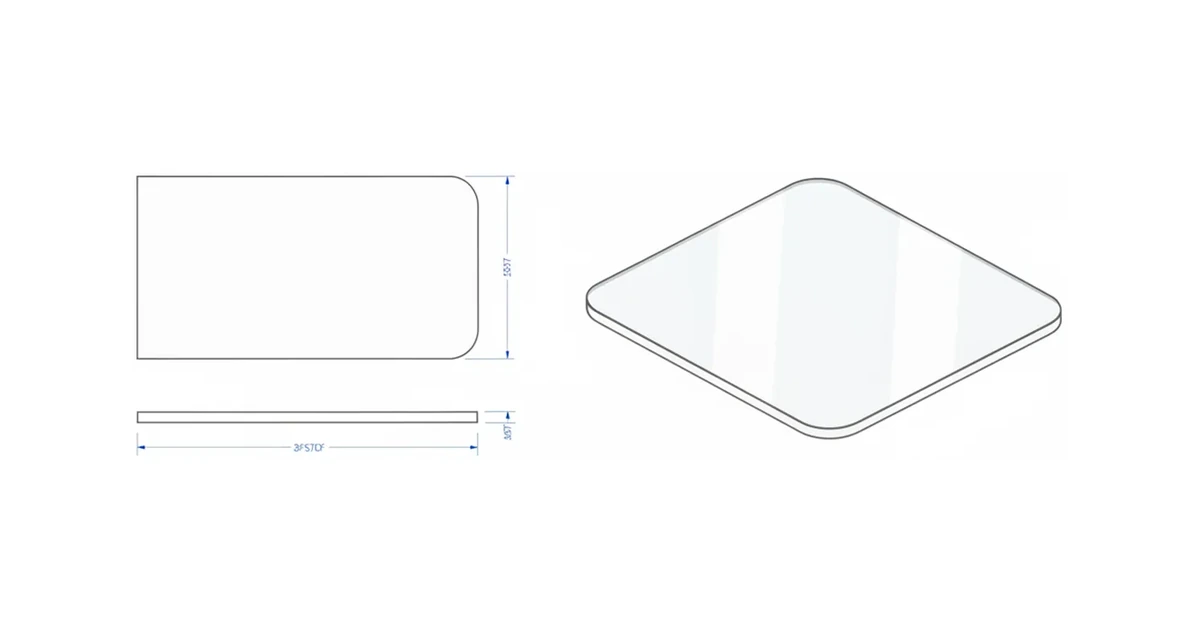
A custom glass table top in Sacramento usually runs about $10 to $35 per square foot for standard tempered glass, with thicker stock and specialty options pushing toward $75 per square foot (Tablesroom, 2025). A small protective cover lands near the bottom. A thick, freestanding dining top climbs near the top. Those are national and California-wide planning ranges, not a fixed Sacramento price. The only number that matters for your table is a measured quote on your actual dimensions. Below is how thickness, glass type, edges, and corners move the bill, so you walk into that quote knowing what drives the cost.
Key Takeaways
- Budget roughly $10-$35/sq ft for a standard tempered glass table top, more for thick or specialty glass (Tablesroom, 2025).
- Tempered glass is the safer choice for any working surface; it breaks into small blunt pieces instead of sharp shards (Glass Helper, 2025).
- Use 1/4 inch for protective covers, 3/8 to 1/2 inch for standalone tops that carry their own weight (Florian Glass, 2025).
- Flat and pencil edges cost about the same; beveled edges cost more because grinding wastes glass and takes skilled labor (Fab Glass and Mirror, 2025).
How much does a custom glass table top cost?
Plan on $10 to $35 per square foot for a standard custom-cut tempered glass top in 2025, with premium thickness or specialty glass reaching toward $75 per square foot (Tablesroom, 2025). Plain annealed glass sits lower, around $8 to $14 per square foot (Tablesroom, 2025). Edge finishing and corner work are quoted on top of the glass.
Two things surprise people. First, price does not climb in a straight line with thickness. One buyer reported a roughly one-meter-square top at about $350 in 1/2 inch, but the same top in 5/8 inch ran well over $1,000 (Tablesroom, 2025). Second, glass and edge work are priced on different units. Glass is sold by the square foot. Edge polishing is priced by the linear foot of perimeter. Ask for both lines on your quote.
Here is how common table types tend to stack up. Treat these as planning ranges to localize with a real Sacramento quote, not Sacramento averages.
| Use case | Typical glass | Why |
|---|---|---|
| Protective cover over wood | 1/4 inch | Table does the structural work (One Day Glass, 2025) |
| Coffee or side table | 1/4 to 3/8 inch | Light loads, smaller span (Florian Glass, 2025) |
| Desk or small dining top | 3/8 inch | The common “sweet spot” (Florian Glass, 2025) |
| Standalone dining table | 1/2 inch | Carries weight on a base or legs (Florian Glass, 2025) |
| Large freestanding top | 3/4 inch | No frame, big unsupported span (Florian Glass, 2025) |
Should a glass table top be tempered?
For any surface people use, yes. Tempered glass is annealed glass reheated past 600 degrees Celsius and rapidly cooled, which makes it about four to five times stronger and forces it to break into small, blunt fragments instead of long sharp shards (Glass Helper, 2025). That break pattern is the whole point on a dining table.
Annealed glass is the basic float glass: clear, cheap, easy to cut, but it breaks into large dangerous pieces (Glass Helper, 2025). It really only makes sense as a thin protective overlay inside a frame, where it is not the working surface (Glass Helper, 2025). Tempering runs roughly 20 to 40 percent more than annealed, and that premium buys you the safe break and better heat tolerance (Glass Helper, 2025).
One real caveat. Tempered glass resists a face hit hard but is vulnerable on the edges and corners; a sharp tap on an exposed corner can trigger the whole panel (Glass Helper, 2025). That is exactly why we steer families toward radius corners and a finished edge, not bare points.
What thickness do I need?
The right thickness depends on one question: does the glass carry its own weight, or does a table underneath carry it? A cover that rests on a wood top needs no strength of its own, so 1/4 inch (6mm) is the standard (One Day Glass, 2025). A standalone top sitting on a base must support itself plus everything on it, so go thicker.
For standalone dining tables and desks, the practical range is 3/8 to 1/2 inch, and 3/8 inch often hits the sweet spot of sturdy yet elegant (Florian Glass, 2025). Coffee and patio tables do fine at 1/4 inch (Florian Glass, 2025). Large freestanding tops with no frame step up to 3/4 inch for stability (Florian Glass, 2025).
Protective cover or full top?
A protective cover sits on an existing surface to guard against spills, scratches, and UV fading; the furniture beneath does the work, so 1/4 inch (or 3/16 inch on small pieces) is plenty (One Day Glass, 2025). A full top is the actual table surface, supported only by a base or legs, and needs the 3/8 to 1/2 inch range above (Florian Glass, 2025). Even covers should step up if any dimension passes 24 inches or the table holds heavy objects (One Day Glass, 2025).
| Thickness | Best for | Notes |
|---|---|---|
| 3/16 in | Small covers | Light scratch and UV protection (One Day Glass, 2025) |
| 1/4 in | Covers, coffee, patio | Standard cover thickness (Florian Glass, 2025) |
| 3/8 in | Desks, small dining | The common sweet spot (Florian Glass, 2025) |
| 1/2 in | Standalone dining | Carries its own load (Florian Glass, 2025) |
| 3/4 in | Large freestanding | No frame, big span (Florian Glass, 2025) |
Which edge finish should I pick?
Edges are smoothed for safety and looks, and the style you pick changes both. A pencil-polished edge is a rounded, glossy profile shaped like the tip of a pencil; because there is no flat plane to catch a knock, it resists chipping and is one of the safest, most popular choices for homes with kids (Fab Glass and Mirror, 2025).
A flat-polished edge is ground straight, smooth, and parallel to the glass face for a clean, modern, commercial look; most flat polishes add a small 45-degree chamfer top and bottom to soften the sharpness (Fab Glass and Mirror, 2025). A beveled edge is the glass face ground at an angle around the perimeter to create a decorative slanted border that adds depth; it needs glass thicker than 1/4 inch to hold the cut (Fab Glass and Mirror, 2025).
Flat and pencil polishes cost about the same. Beveled costs more, because the angled cut grinds away material and takes a more skilled, slower pass (Fab Glass and Mirror, 2025).
| Edge | Look | When to pick it |
|---|---|---|
| Flat polished | Straight, modern, sits flush | Minimalist tops, metal or wood bases (Fab Glass and Mirror, 2025) |
| Pencil polished | Rounded, soft, glossy | Kids, high-traffic, daily use (Fab Glass and Mirror, 2025) |
| Beveled | Angled decorative facet | Statement dining, formal rooms (Fab Glass and Mirror, 2025) |
What about corners?
Square and rectangular tops get a separate corner choice, and it matters more for safety than people expect. Radius corners are rounded to a set radius such as 1, 2, or 4 inches, leaving no sharp point; they are the safest option for furniture touched by children (Express Toughening, 2025). Clipped corners cut the point off at a 45-degree angle for a sharp, contemporary feel (Fab Glass and Mirror, 2025).
The simplest is a dubbed or nipped corner, a tiny 1/8 inch rounding that just takes off the sharp edge (Express Toughening, 2025). One technical note: dubbed corners work on any thickness, but radius corners need glass 6mm or thicker, so a true rounded corner pairs with a real top, not a paper-thin cover (Express Toughening, 2025). More corner work means more cost, since each rounded or clipped corner is extra fabrication beyond a plain polished rectangle (Express Toughening, 2025).
A field note: when a family tells us the table sits in a walkway or a kids’ room, we almost always pair a pencil-polished edge with radius corners. The combo looks soft, and there is simply no hard point at shin or hip height to walk into.
Thickness and safety on large tops
Bigger tops are not just heavier; they are riskier if you under-spec them. A free span of glass has to support its own weight before it ever holds a plate (Florian Glass, 2025). Go too thin on a wide unsupported top and it flexes, then fails. That is why large freestanding designs move to 3/4 inch (Florian Glass, 2025).
Two points deserve attention. The base has to carry the glass; a heavy 1/2 or 3/4 inch top on an undersized stand can compromise the whole table (One Day Glass, 2025). And thick tempered glass is heavy and awkward, with a cracked corner enough to let the whole panel go. The most common do-it-yourself mistake we see is a top cut to the base footprint with hard square corners; it looks fine on day one, then someone catches a corner. We would rather round those corners and finish the edge than replace a shattered top later.
Why use a licensed glazier or glass shop?
Tempered glass cannot be cut, drilled, or ground after tempering; any of that triggers it to shatter (Glass Helper, 2025). Every dimension, edge, corner, and cutout has to be finalized before the glass goes into the furnace. There is no trimming on site. That puts the weight on accurate measuring and clean fabrication, exactly what a glass shop is set up to do.
Working with a licensed glazier gives you a measured template, the right glass type and thickness for your load, finished edges and corners, and safe handling of heavy panels. Capital Glazing holds California license CSLB #1115205 (B, C-17, C-33) and serves the greater Sacramento area from our glass and mirror shop in Rancho Cordova. For non-standard shapes, cutouts, or matching an old top, our custom glass work covers measuring through install. When you are ready for a real number, request a quote on your dimensions.
Frequently asked questions
How thick should a glass dining table top be?
For a standalone dining table on a base or legs, 3/8 to 1/2 inch is the practical range, with 3/8 inch a common sweet spot of strength and looks (Florian Glass, 2025). If the glass is only protecting a wood table beneath it, 1/4 inch is enough (One Day Glass, 2025).
Is tempered glass worth the extra cost for a table?
For a working surface, yes. Tempering runs about 20 to 40 percent more than annealed, and in return the glass is several times stronger, handles heat better, and breaks into blunt fragments instead of sharp shards (Glass Helper, 2025). That safe break is the reason it is the standard for dining and coffee tables.
Can you cut tempered glass to fit my table?
No. Tempered glass cannot be cut or ground after it is tempered without shattering (Glass Helper, 2025). The size, edge, corners, and any holes are set before tempering, which is why accurate measuring up front matters so much.
Which edge is safest for a glass table top?
A pencil-polished edge. Its rounded profile has no flat plane to catch a knock, so it resists chipping and is one of the safest, most popular choices for high-traffic homes (Fab Glass and Mirror, 2025). Pair it with radius corners for the safest combination.
What thickness do I need for a glass cover over a wood table?
For a protective cover, 1/4 inch (6mm) is the standard, since the wood table carries the load (One Day Glass, 2025). Small pieces can drop to 3/16 inch, but step up if any dimension passes 24 inches or the table holds heavy items (One Day Glass, 2025).
About Capital Glazing
Capital Glazing is a licensed glazier based in Rancho Cordova, serving homeowners and businesses across the greater Sacramento area. We hold California contractor license CSLB #1115205 with B, C-17, and C-33 classifications, and we handle custom table tops from measuring and glass selection through edge work, corners, and delivery. You can learn more about us or talk through your project with someone who will actually measure it.
Ready for a real number on your table? Request a quote, email info@cglazing.com, or call us at (916) 720-9009.