
Capital Glazing guide
Glass Railing Contractor Cost & Options in Sacramento (2026)
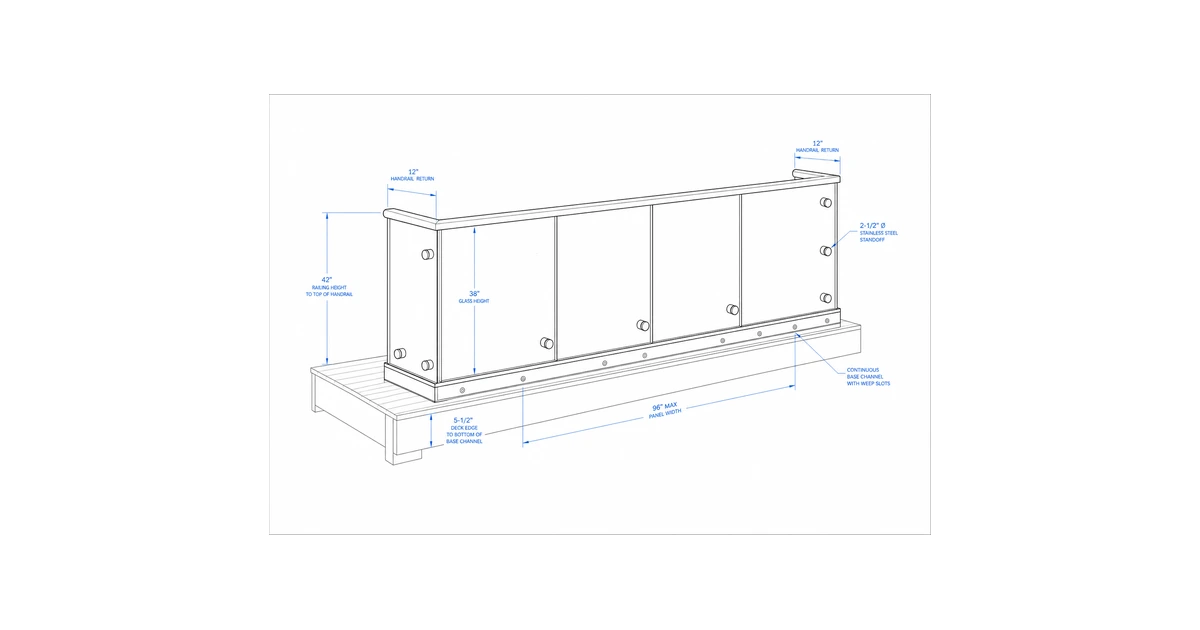
A glass railing contractor in the Sacramento area installs glass railings for roughly $150 to $600 per linear foot, depending on the system: framed runs lower, frameless runs highest (HomeGuide, 2026; AG, 2026). Materials are about $100–$400 per foot and labor adds $50–$200 (HomeGuide, 2026). Your real number depends on the system, glass thickness, hardware, and the railing’s height and span — so we measure on site before we quote, rather than guess a flat Sacramento average.
That measured-quote habit matters here more than on most jobs. Glass guards are an engineered, code-governed assembly, not a decorative add-on. Below we break down what each system costs, how California code controls the glass and the hardware, and the questions buyers ask most.
Key Takeaways
- Installed cost by system: framed ~$150–$300/ft, semi-frameless ~$250–$400/ft, frameless ~$400–$600+/ft (HomeGuide, Viewrail, 2026).
- California code requires laminated tempered/heat-strengthened glass in guards over a walking surface (CBC Ch. 24).
- Guards must be 42 inches high (stairs 34–38 in.) and resist a 50 lb/ft load (CBC 2025, Ch. 24/§1015).
- A licensed glazier handles the structural calc, the permit, and the code-compliant glass — that is most of what you are paying for.
What Does a Glass Railing Cost Per Foot?
A glass railing costs about $150 to $600 per linear foot installed, and the system type sets where you land in that range (HomeGuide, 2026). Framed systems are the budget option. Frameless is the premium look and price. Semi-frameless sits in the middle.
The price splits into materials and labor. Materials — glass panels, posts or a base shoe, and mounting hardware — run roughly $100–$400 per foot. Labor adds another $50–$200 per foot, and it climbs with thicker glass, tricky access, and stair work (HomeGuide, 2026). A handrail, when you want one, is often a separate $50–$200 per foot.
| System | Typical installed cost (per linear foot) | Look |
|---|---|---|
| Framed (budget) | $150–$300 | Glass set inside a top and bottom frame with posts |
| Semi-frameless (mid) | $250–$400 | Thinner glass on posts or clamps, fewer visible parts |
| Frameless (premium) | $400–$600+ | Thick glass on standoffs or a base shoe, minimal hardware |
Sources: HomeGuide, Viewrail, and AG Fencing, 2026. Treat these as national/California ranges. A Sacramento number comes from a measured quote, not a blog post — request one here.
Frameless vs. Semi-Frameless: Which Is Right?
A frameless glass railing holds the glass with discreet standoffs or a recessed base shoe, so there is almost no visible hardware and the view stays open. It is the premium choice at roughly $400–$600+ per foot, and it uses thicker glass and specialized mounting (Insight Glass, 2026). It is our most-requested system for decks and balconies where the view is the point.
A semi-frameless glass railing carries the glass on posts or clips. You still get a clean look, but with more support and thinner, less expensive glass — so it lands around $250–$400 per foot. It is a strong middle ground for a budget that still wants modern lines.
So the trade-off is simple. Frameless buys you the cleanest sightline at the highest price. Semi-frameless trades a little visibility for real savings. For stairs, wind-exposed balconies, or tall panels, the glass spec and mounting change, which is exactly where an on-site look pays off.
Do Glass Railings Have to Meet California Code?
Yes. In California, glass used in a guard over a walking surface must be laminated glass made of fully tempered or heat-strengthened glass, meeting Category II of CPSC 16 CFR Part 1201 or Class A of ANSI Z97.1 (CBC 2025, Ch. 24). Single tempered glass is only allowed where nothing can be walked on below. This is the rule that separates a compliant railing from one that fails inspection.
The code controls more than the glass. Here is what a Sacramento glass railing has to satisfy:
- Height: guards are a minimum of 42 inches; stair guards run 34–38 inches (CBC §1015).
- Load: the assembly must resist 50 pounds per linear foot, plus a 200-pound point load in any direction.
- Gaps: no opening may let a 4-inch sphere pass below the required guard height.
- Glass: laminated tempered/heat-strengthened, minimum 1/4 inch nominal; frameless panels are commonly 1/2 inch or thicker for wind and height.
- Top rail: structural glass baluster systems need an attached top rail unless the laminated panels are tested to ASTM E2353 (CBC §2407).
Structural calculations are required for guardrails, and the design has to detail every attachment — the base shoe, the posts, and the top rail. Skipping a permit or using the wrong glass is the costly shortcut: it can fail inspection and create real liability if a guard gives way. Capital Glazing holds CSLB #1115205 (B, C-17, C-33) and builds to current CBC requirements.
Deck, Balcony, or Stairs — Does It Change the Price?
Yes, the location changes the glass, the hardware, and the labor. A ground-level interior railing is the simplest. A wind-exposed balcony or a tall deck guard needs thicker glass and stronger mounting, which raises both material and labor cost. Stairs are the most labor-intensive because each panel is raked to the stringer and the height rules differ.
Access matters too. A second-story balcony, a long carry, or a tight site adds labor hours. None of that shows up in a per-foot “average,” which is why two similar-looking railings can quote differently. For example, the same 30 feet of glass costs more on a windy upper balcony than on a flat ground-floor patio.
Why Hire a Licensed Glass Railing Contractor?
A licensed glass railing contractor matters because the price reflects engineering and code, not just glass. The contractor sizes the glass for the load and wind, runs the structural calculation, pulls the permit, specifies laminated safety glazing, and labels it so the work passes inspection. That is most of what separates a real quote from a cheap one.
It also protects you. A railing that fails a load test or an inspection is not a finished railing — it is a redo, plus liability. We measure on site, confirm the code path for your specific guard, and price the full assembly so the number holds.
Frequently Asked Questions
How much does a glass railing cost per foot? A glass railing costs about $150–$600 per linear foot installed: framed ~$150–$300, semi-frameless ~$250–$400, and frameless ~$400–$600+ (HomeGuide, Viewrail, 2026). Materials are ~$100–$400/ft and labor ~$50–$200/ft. Get a measured quote to localize it.
What glass is used in a glass railing? In California, guards over a walking surface use laminated glass made of tempered or heat-strengthened glass, per CBC Chapter 24 (CBC 2025). Minimum nominal thickness is 1/4 inch; frameless panels are often 1/2 inch or more for height and wind load.
How tall does a glass railing have to be? Guards must be at least 42 inches high in most locations, with stair guards between 34 and 38 inches (CBC §1015). The system must also resist a 50 lb/ft load and block a 4-inch sphere below the guard height.
Is frameless or semi-frameless better? Frameless gives the cleanest, most open view at the highest price (about $400–$600+/ft). Semi-frameless keeps a modern look with more support and lower cost (about $250–$400/ft) (Insight Glass, 2026). The right pick depends on the view, the location, and the budget.
Do I need a permit for a glass railing in Sacramento? Guardrails require structural calculations and typically a permit, and local jurisdictions can add requirements (CBC 2025, Ch. 24). A licensed contractor handles the calc, the permit, and code-compliant glass.
Get a Glass Railing Quote
Glass railings are an engineered, code-driven assembly, so the honest price comes from measuring your deck, balcony, or stairs — not from a national average. Request a quote and we’ll spec a compliant glass railing for your space, or see our glass railing service. You can also email info@cglazing.com or call Capital Glazing at (916) 720-9009.
About Capital Glazing
Capital Glazing is a licensed glazier (CSLB #1115205, classes B, C-17, C-33) in Rancho Cordova, serving the greater Sacramento region with glass railings, commercial storefront glazing, and glass repair. This guide was written and reviewed by our licensed glazing team against the current California Building Code and 2026 cost data, and every figure links to its source. We publish ranges rather than a single Sacramento average on purpose — an accurate number comes from measuring your railing, not from a blog post. Learn more about Capital Glazing or request a quote.