
Capital Glazing guide
Fire-Rated Glass for Sacramento Buildings (2026)
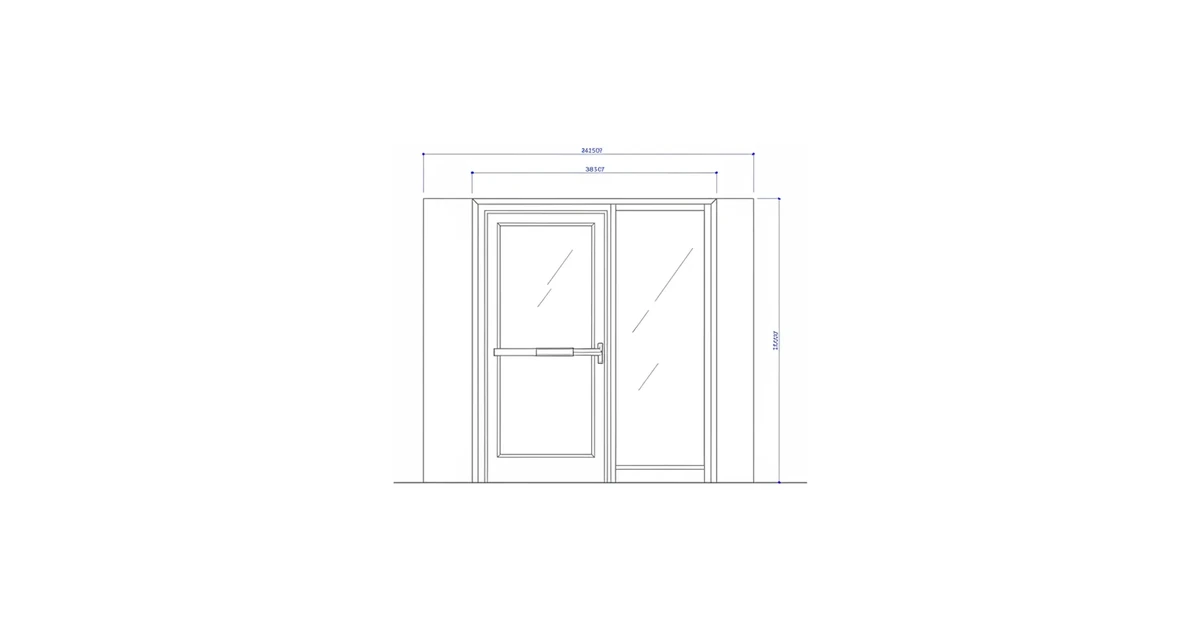
Fire-rated glass holds back flames and smoke for a set number of minutes during a fire, and Sacramento building code requires it in specific places: fire-rated doors, exit corridors and stairwells, and exterior openings close to a property line (SAFTI FIRST, 2025; ICC Digital Codes, 2021). It splits into two families. Fire-protective glass blocks flame and smoke; fire-resistive glass does that and also blocks the radiant heat that can ignite a room from across a wall (National Glass Association, 2023). It is a premium product, and the prices below are national ranges. The only accurate number for your building comes from an on-site quote.
That distinction is the whole game. Pick the wrong family for the opening and the building official rejects it, even if the minute rating looks right. Below: the two types, the 20 to 90 minute ratings, where the California Building Code demands fire-rated glass, why old wired glass is on its way out, and what it costs.
Key Takeaways
- Fire-rated glass comes in two families: fire-protective (blocks flame and smoke) and fire-resistive (also blocks radiant heat), and the code does not let you swap one for the other (National Glass Association, 2023).
- Ratings run 20, 45, 60, and 90 minutes; openings up to 45 minutes usually take fire-protective glass, while 60 minutes and above usually call for fire-resistive (fireglass.com, 2025).
- Traditional wired glass lost its safety exemption in the 2006 IBC and can no longer go in doors, sidelites, or other impact-hazard spots (Safe Glass for Schools, 2023).
- Fire-protective ceramic glass starts around 100 dollars per square foot for the glass alone, before framing and labor (New Angle Beveling, 2025).
What Is Fire-Rated Glass?
Fire-rated glass is glazing tested to hold back fire for a labeled period, measured in minutes, so a wall or door can do its job long enough for people to get out. Not all of it works the same way, and the difference decides where it is allowed.
Fire-protective glazing is glass that defends against the spread of flames and smoke for its rated time. It covers traditional wired glass, glass ceramics, and specially tempered glass. Because it does not stop radiant heat, the code limits how much of a wall it can fill (SAFTI FIRST, 2025).
Fire-resistive glazing does everything fire-protective glass does and adds one thing: it blocks the transfer of radiant heat. It is tested to the same standards as a fire-rated wall, ASTM E119 and UL 263, so the code treats it almost like a transparent wall (National Glass Association, 2023).
Why does radiant heat matter? Fire-protective glass can stay intact while heat pours straight through it, hot enough to ignite paper on the other side. Fire-resistive glass keeps the non-fire surface below a defined temperature, which is why it carries far fewer restrictions in the code (fireglass.com, 2025).
Fire-Protective vs Fire-Resistive: How They Differ
Both block flame and smoke. Only fire-resistive glass blocks radiant heat, and that single property changes its test standard, its code treatment, and its price. The table below is the short version.
| Feature | Fire-protective | Fire-resistive |
|---|---|---|
| Blocks flame and smoke | Yes | Yes |
| Blocks radiant heat | No | Yes |
| Common ratings | 20 to 45 min uses | 60 min and above |
| Code treatment | Opening protective, size-limited | Treated like a rated wall |
Sources: National Glass Association (2023) and fireglass.com (2025).
One caution worth repeating: the minute rating alone does not tell you which family you need. A 60-minute product can be either type, and relying on the duration number by itself is how specs get rejected (SAFTI FIRST, 2025).
What Do the 20, 45, 60, and 90 Minute Ratings Mean?
The number is how long the glazing held back fire in a standard furnace test. The rating you need follows the wall or door it sits in, not preference. In rough terms, openings rated up to 45 minutes commonly use fire-protective glass, while 60 minutes and above commonly call for fire-resistive (fireglass.com, 2025).
Fire-protective products run from 20 minutes up to 180, but the higher you go, the tighter the limits. Because the glass cannot stop radiant heat, it is generally capped at 25 percent of the wall area, and in 60 and 90 minute doors the clear vision area is held to 100 square inches (SAFTI FIRST, 2025). Fire-resistive glass carries no such application limits and can run up to the largest size it was tested at (National Glass Association, 2023).
Where Does Sacramento Code Require Fire-Rated Glass?
California buildings follow the California Building Code, which adopts the International Building Code with state edits. Fire-rated glass is required wherever a rated wall, door, or partition has an opening in it. The most common spots are fire doors, exit corridors and stairwells, and exterior walls near a property line (ICC Digital Codes, 2021).
A fire-rated wall is only as good as its weakest opening. Every door, window, and sidelite punched into it has to keep the rating, and ordinary glass cannot. Here is where it shows up most.
| Location | Why it needs fire-rated glass |
|---|---|
| Fire-rated doors | Vision lites must hold the door’s rating |
| Exit corridors and stairwells | Protect the escape path from smoke and flame |
| Openings near a property line | Stop fire spreading to the next building |
| Occupancy and tenant separations | Keep one unit’s fire out of the next |
Sources: ICC Digital Codes (2021) and SAFTI FIRST (2025).
Doors, Sidelites, and Vision Panels
Glazing inside a fire door is held to strict size limits. Fire-protective vision panels in most rated doors cannot exceed 100 square inches, and in exit enclosures, sidelites and transoms cannot use fire-protective glass at all. Fire-resistive glazing is the way to get a larger window in a rated door or to glaze the panels beside it (SAFTI FIRST, 2021). Exit stairwell doors add a temperature-rise rule, one more reason the glass and the door get specified together rather than separately (SAFTI FIRST, 2021).
Openings Near a Property Line
Exterior openings are governed by fire separation distance, measured straight out from the wall to the property line. The closer the wall sits, the less glass you are allowed and the more of it must be protected (ICC Digital Codes, 2021). On a tight infill lot in midtown Sacramento, that rule alone can decide how much glass a storefront facade is even permitted to have. Where the separation distance is very small, unprotected openings are not allowed at all without a sprinkler system, and the protected percentage climbs as the distance grows (SAFTI FIRST, 2025). Settle this with your architect and the building department early, not after the glass is ordered.
Why Is Old Wired Glass Disappearing?
Traditional wired glass looks tough, but the wire actually weakens it, and it can shatter under a push from a small child while the embedded wire snags the limb that breaks through (Safe Glass for Schools, 2023). For decades it rode a 1977 exemption from the federal impact-safety standard, granted because manufacturers said no safer fire-rated option existed (Safe Glass for Schools, 2023).
That changed once better products arrived. The 2003 IBC pulled wired glass’s exemption in schools and athletic facilities, and the 2006 IBC removed it in all new construction and all occupancies. Today wired glass can no longer go in doors, sidelites, or any other impact-hazard location, and any replacement for broken wired glass has to meet the safety standard too (Safe Glass for Schools, 2023).
I still find old wired glass in Sacramento-area buildings put up before those code cycles, usually in a stairwell door or a corridor lite nobody has touched in decades. It is not automatically illegal where it sits, but the moment it breaks, the replacement has to be a modern fire-rated, impact-safe product. We get that call more than people expect.
Ceramic and Specialty Fire Glass
The replacement for wired glass is usually glass-ceramic. It is a clear, fire-protective material rated as high as three hours, and unlike old wired glass it passes the impact-safety tests, ANSI Z97.1 and CPSC 16 CFR 1201, so it is allowed in doors and hazardous locations (New Angle Beveling, 2025; Trudoor, 2025). For larger openings or anywhere radiant heat is a concern, the step up is a fire-resistive product, typically a multi-layer laminated assembly.
How Much Does Fire-Rated Glass Cost?
Expect a premium. Fire-protective ceramic glass starts around 100 dollars per square foot for the glass alone, against roughly 50 dollars for the older wired product, before framing and installation (New Angle Beveling, 2025). A single labeled 90-minute ceramic lite from a name-brand line can run well over 150 dollars for a small cut-to-size panel (Trudoor, 2025).
Several things move the number: the rating, fire-protective versus fire-resistive, size and shape, impact-safety treatment, and the steel or steel-clad framing the assembly requires (New Angle Beveling, 2025). Filmed and laminated ceramics sit at the top of the range and can cost several times more than specialty tempered glass for the same 20-minute door (SAFTI FIRST, 2025). Those are national figures. A Sacramento quote prices your exact opening, rating, and frame.
Why Use a Licensed Glazier for Fire-Rated Work?
Fire-rated glass is one place where the label and the install both matter. The glass carries a permanent mark stating its rating, the tests it passed, and the locations it is approved for, and the building official reads that label at inspection (National Glass Association, 2023). Use the wrong family, oversize the lite, or pair the glass with a non-rated frame, and the assembly fails its purpose and its inspection.
A licensed commercial glazier specifies the glass, frame, and hardware as one tested system and keeps the documentation a Sacramento inspector expects. Capital Glazing holds CSLB license #1115205 (B, C-17, C-33) and works throughout the greater Sacramento area. On storefront and partition work, we flag fire-rated openings up front so they are designed right the first time. The same care applies to commercial glass repair and full commercial storefront installation.
Frequently Asked Questions
Is fire-rated glass the same as safety glass? No. Safety glass resists impact so it does not cause injury when it breaks. Fire-rated glass resists fire for a set time. Modern fire-rated products are usually both, but the older wired glass was fire-rated without being impact-safe, which is why it lost its place in doors (Safe Glass for Schools, 2023).
Can I replace a broken fire-rated lite with ordinary glass? No. Any replacement in a rated opening must meet the same fire rating and the current impact-safety standard. Putting plain glass in a fire door defeats the wall and will not pass inspection (Safe Glass for Schools, 2023).
Does fire-rated glass look cloudy or have a tint? Older wired and some ceramic products carried a faint amber cast. Premium clear glass-ceramics are made to read like ordinary glass without the tint, which is part of why they cost more (Trudoor, 2025).
How do I know which rating my opening needs? The rating follows the wall or door the opening sits in, set by the building code and your design plans. Your architect or the building department assigns it; a glazier then matches the right family and size to that requirement (ICC Digital Codes, 2021).
Is fire-rated glass required in a sprinklered building? Often, yes. Sprinklers can change some allowances, but the 2012 IBC removed an old exception that let large fire-protective vision panels into exit-enclosure doors just because a building was sprinklered (SAFTI FIRST, 2021). Treat the rated openings as required unless your plans say otherwise.
About Capital Glazing
Capital Glazing is a commercial glass contractor based in Rancho Cordova, serving the greater Sacramento area. We hold CSLB license #1115205 with B, C-17, and C-33 classifications, and we handle fire-rated openings, storefronts, partitions, and glass repair as complete, code-correct assemblies. You can learn more about us on our about page.
If your project has a fire-rated opening, or you are not sure whether one applies, request a quote and we will help you get it specified right. Reach us through our contact page, email info@cglazing.com, or call (916) 720-9009.