
Capital Glazing guide
Custom Mirrors in Sacramento: Sizes, Cuts & Cost (2026)
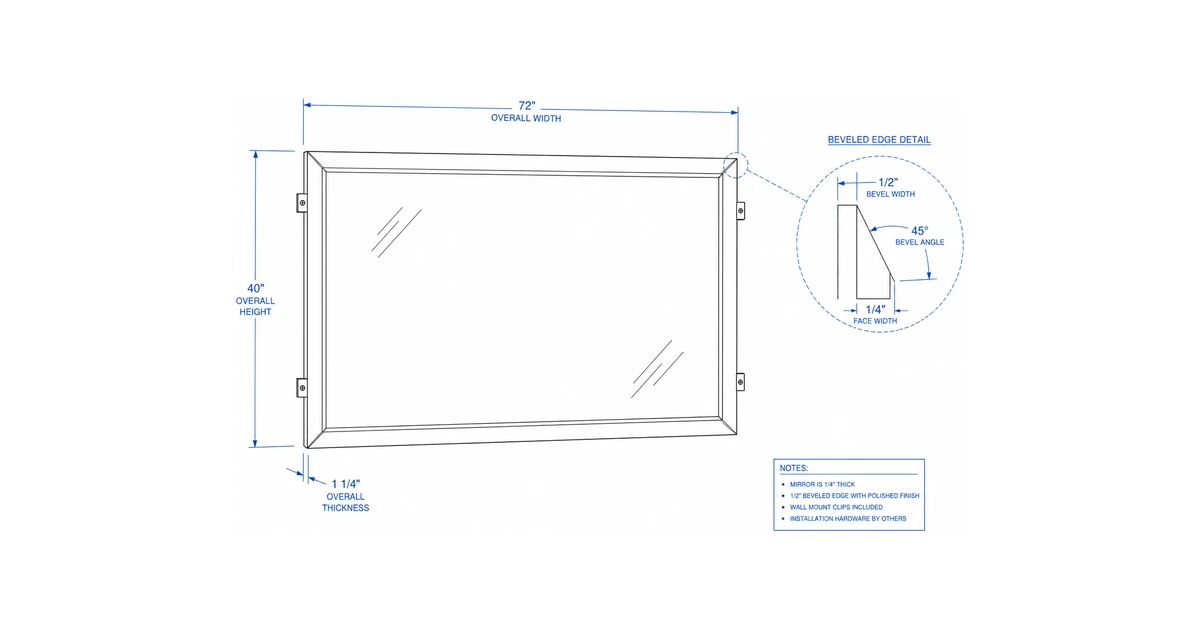
Custom mirrors in Sacramento usually start around $10 to $25 per square foot for the glass alone, with edge work and installation added on top (NY Glazing, 2025). A small frameless vanity piece lands near the bottom of that range. A wall-to-wall gym or dance mirror climbs well past it. Those figures are national and California-wide ballparks, not a fixed Sacramento price. The only number that matters for your wall is a measured, on-site quote. Below is how sizing, cuts, thickness, and safety backing move the total, so you walk into that quote knowing what drives the bill.
Key Takeaways
- Budget roughly $10-$25/sq ft for the mirror glass, then add edge work and labor; oversized pieces cost more per square foot to handle (NY Glazing, 2025).
- 1/4-inch (6mm) glass is the standard for wall and vanity mirrors; thinner glass can warp in humid bathrooms (Glass and Auto, 2026).
- Beveled edges run 10-30% more than polished because beveling wastes glass and takes skilled labor (Installix, 2025).
- Large or public mirrors should carry CAT II safety backing and proper mechanical mounting, not adhesive alone.
How much do custom mirrors cost?
Plan on $10 to $25 per square foot for the mirror glass itself in 2025, before edges and labor (NY Glazing, 2025). Edge finishing and installation are quoted separately, so a small custom piece can total a couple hundred dollars while a full-wall job runs into the thousands. Size, edge style, thickness, and access all shift the number.
Two things catch people off guard. First, big mirrors cost more per square foot, not less, because oversized glass is fragile and awkward to transport and lift (HomeGuide, 2026). Second, the glass and the edge work are priced on different units. Glass is priced by the square foot. Edge polishing or beveling is priced by the linear foot of perimeter. Ask for both lines on your quote.
Here is how common mirror types tend to stack up. Treat these as planning ranges to localize with a real Sacramento quote, not Sacramento averages.
| Mirror type | Typical cost range | Notes |
|---|---|---|
| Frameless vanity / accent (24” x 30”) | ~$30-$90 installed | Small flat-mounted pieces are the cheapest (Angi, 2026) |
| Standard 1/4-inch wall mirror | ~$7-$16+/sq ft installed | Excludes framing, lighting, or accent tile (New Angle Beveling) |
| Framed bathroom mirror replacement | ~$80-$200 | Steel or wood frame, install included (HomeGuide, 2026) |
| Full-length / full-wall | Higher end of ranges | Two installers, heavier handling (HomeGuide, 2026) |
| Gym / dance studio wall | Can exceed $7,000 | Large area plus safety backing (Angi, 2026) |
| Antiqued / specialty glass | Add-on premium | Tinted, antiqued, and low-iron cost more than clear (NY Glazing, 2025) |
Labor is its own line. Pros generally charge $75 to $150 an hour, and most residential mirror jobs take one to three hours, so figure $150 to $450 in labor for a typical install (Angi, 2026). Large frameless mirrors that need two installers can run $200 to $600 in labor alone (Angi, 2026).
What thickness should a mirror be?
For nearly every wall and vanity mirror, 1/4-inch (6mm) glass is the standard. It resists warping, holds a flat reflection, and handles a large span without the wavy distortion thinner glass shows in damp rooms (Glass and Auto, 2026). Thinner stock costs less but is more prone to warping over time in humid bathrooms.
Thickness drives material cost directly. Each added millimeter adds roughly 15 to 25% to the glass cost; a 3mm mirror might run $6 to $10 per square foot while the same mirror in 6mm runs $12 to $18 per square foot (Glass and Auto, 2026). Going heavier than needed wastes money. Going lighter on a big wall invites distortion.
A frameless mirror is a mirror with no surrounding frame, so its raw edge is finished directly on the glass. That makes the edge treatment a visible design choice rather than something a frame hides.
Polished vs. beveled edges?
A polished edge is flat-ground smooth for a clean, modern look that sits tight to the wall. A beveled edge adds an angled, decorative facet around the perimeter. A beveled edge is glass ground at an angle, usually 1/2 inch to 2 inches wide at roughly 22 to 25 degrees, creating a prismatic border that catches light (Installix, 2025).
Beveling costs more for a real reason. It grinds glass away, which means waste, a larger starting blank, slower work, and a more skilled operator to keep the bevel even on all four sides (Installix, 2025). Expect beveled edges to run 10 to 30% more than polished, with edgework commonly adding $50 to $200 (NY Glazing, 2025). Beveled work is also quoted by the linear foot, often around $8 to $15 per linear foot (Angi, 2026).
| Edge / option | What it does | Cost impact |
|---|---|---|
| Flat-polished edge | Smooth, modern, sits flush to wall | Baseline edge finish (Installix, 2025) |
| Pencil-polished edge | Slightly rounded, soft finish | Comparable to flat-polished (Installix, 2025) |
| Beveled edge | Angled prismatic border, decorative | 10-30% more than polished (NY Glazing, 2025) |
| Custom shape / template | Arches, circles, notched corners | Adds ~$50-$200+ in fabrication (Angi, 2026) |
| Etching / sandblasting | Decorative surface detail | ~$50-$500 by complexity (NY Glazing, 2025) |
Custom shapes need a template, which adds $50 to $200 or more in fabrication (Angi, 2026). If you want a curved or notched mirror, that template line belongs in your quote.
How are big mirrors installed safely?
Large mirrors should be held with mechanical fasteners, J-moldings, clips, or framing, not adhesive on its own (Glass Magazine). Adhesive mastic can be used as a supplement, but mechanical support is the recommended primary method for most applications. When a J-molding is used, it should have weep holes, and a 3mm neoprene setting pad belongs between the glass and any clip or molding (Glass Magazine).
Adhesive choice matters. Use a neutral-cure mastic compatible with the mirror’s silver backing, and avoid products with strong solvents or acids like acetone, toluene, or acetic acid, which attack the backing and cause black-edge corrosion over time (Glass Magazine).
Do custom mirrors need safety backing?
For large mirrors and any public or active space, yes. Safety backing is a film bonded to the back of the mirror that holds the fragments together if it breaks, so the glass does not fall in dangerous shards. It is standard for gyms, yoga and dance studios, wardrobe doors, and similar settings, and it is invisible once installed, so it does not dim or distort the reflection.
CAT II safety backing is the higher-impact category, with film that complies with ANSI Z97.1 and 16 CFR 1201 for impact resistance. It comes factory-applied to a finished safety mirror or as a tape applied during fabrication.
A note on safety glazing and code
There is a common assumption that full-coverage mastic counts as “continuous backing support” and exempts a mirror from safety-glazing rules. That phrase is not defined in the IBC, which leaves it open to interpretation by your local building authority (UpCodes). Even where an installation might technically qualify, backing is still recommended for tall or large mirrors so the glass will not break into hazardous shards if struck (UpCodes). The IBC also does not allow mirrored glass on egress doors, since exits must stay clearly recognizable (Glass Magazine).
This is exactly where a licensed glazier earns the fee. Specifying the right thickness, the right backing, code-aware mounting, and a backing-safe mastic is not guesswork. It is the difference between a mirror that lasts and one that corrodes, sags, or fails dangerously. Our glass and mirror shop in Rancho Cordova cuts, finishes, and installs to spec, and our custom glass work covers shapes and treatments beyond standard rectangles.
Frequently asked questions
How are custom mirrors measured? Measure width and height of the finished opening, and note any obstructions like outlets, sconces, or a backsplash lip. For a precise fit, especially on shaped or wall-to-wall pieces, a glazier field-measures and templates on site before cutting.
Can you cut a mirror to any size or shape? Yes. Mirrors are cut to size and can be fabricated into circles, arches, or notched rectangles. Specialty shapes need a template, which adds to the fabrication fee (Angi, 2026).
Is an antiqued mirror more expensive? Yes. Antiqued, tinted, and low-iron glass are specialty products priced above standard clear mirror, so they add to the per-square-foot cost (NY Glazing, 2025).
Do I need safety backing for a bathroom vanity mirror? A typical small vanity mirror usually does not require it. Safety backing matters most for large mirrors and active or public spaces like gyms and studios. When in doubt, ask during your quote.
Why does a full-wall mirror cost more per square foot? Oversized glass is heavier, more fragile, and harder to transport and lift, and it often needs two installers, so the per-square-foot rate rises with size (HomeGuide, 2026).
About Capital Glazing
Capital Glazing is a licensed glazier based in Rancho Cordova, CA, serving the greater Sacramento area. We hold California CSLB License #1115205 (classifications B, C-17, and C-33), and we handle custom mirror cutting, edge finishing, safety backing, and code-aware installation for homes and commercial spaces. You can learn more about us on our about page.
Ready for a real number on your wall? Skip the national averages and get a measured, on-site price. Request a quote, email info@cglazing.com, or call us at (916) 720-9009.