
Capital Glazing guide
ADA Storefront Doors in Sacramento: Rules & Cost (2026)
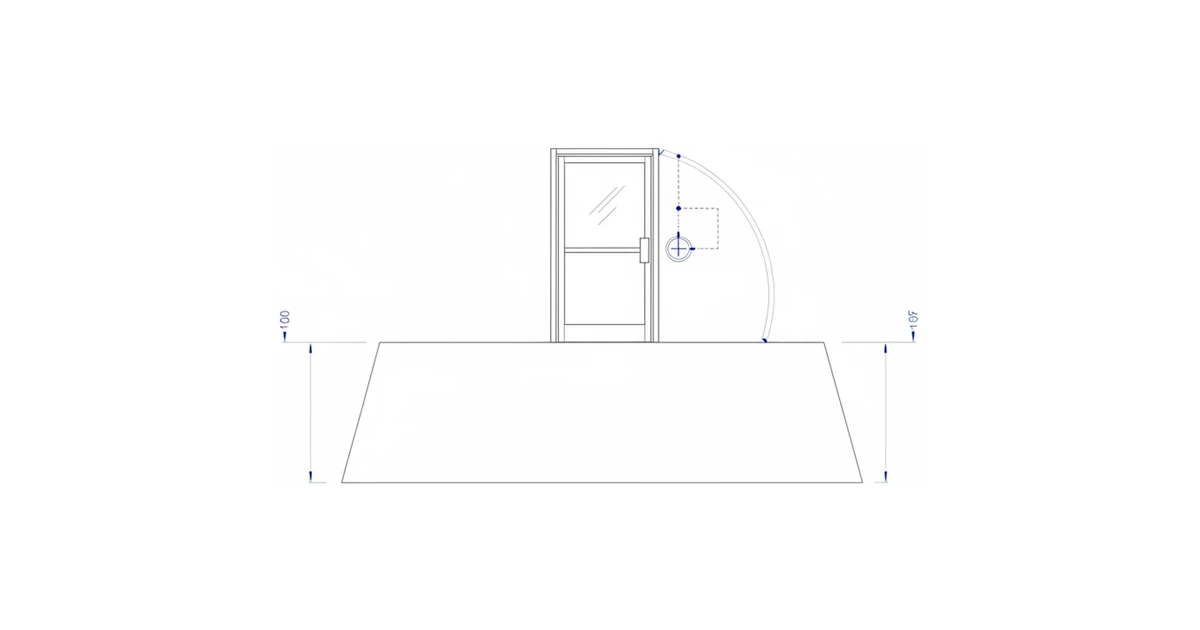
An ADA storefront door has to give at least 32 inches of clear width, use hardware you can work with one closed fist between 34 and 48 inches off the floor, and keep the threshold to half an inch. Adding a single low-energy automatic operator runs roughly $1,300 to $3,500 per leaf installed on top of the door. Those are national and California ranges — your real Sacramento number depends on the existing frame, the hardware, and whether you need power operation. The only way to lock in a fixed price is an on-site quote, which Capital Glazing (CSLB #1115205) provides free across greater Sacramento.
Key Takeaways
- An accessible entry needs 32 in minimum clear width and hardware mounted 34–48 in that works with one hand, no twisting.
- The 5 lbf maximum opening force applies to interior hinged doors under the federal 2010 ADA Standards; California’s CBC Chapter 11B can be stricter, so confirm the exterior-door requirement for your building.
- An automatic operator is the usual fix when a heavy door, weather pressure, or a tight vestibule makes manual use impractical — figure $1,300–$3,500 per leaf installed.
- California law requires safety glazing in and beside doors per CBC Chapter 24, Section 2406.4.
What is an ADA storefront door?
An ADA storefront door is a glazed commercial entry — usually a large lite of glass in an aluminum frame — built so people with disabilities can get through it independently. The door, its hardware, the threshold, and the floor space around it all have to meet the 2010 ADA Standards, Section 404.
Maneuvering clearance is the level, unobstructed floor space a person needs to position a wheelchair, open the door, and pass through. It changes with the approach direction and whether the door has a closer.
A low-energy automatic operator is a powered arm that opens the door when someone presses a plate or waves a hand. It is the most common way to make a heavy or hard-to-pull entrance accessible.
What does ADA require for a storefront door?
An ADA entry needs four things at once: at least 32 inches of clear width, hardware operable with one hand mounted 34–48 inches high, a threshold no taller than 1/2 inch, and enough maneuvering clearance to approach and open it. Each one is measurable, and an inspector checks all of them.
Clear width is measured between the door face and the stop with the door open 90 degrees. Hardware — levers, push bars, offset pulls — must work without tight grasping, pinching, or twisting the wrist, which is why round knobs fail. The threshold caps at 1/2 inch in new construction, bevelled above 1/4 inch.
| ADA spec | Requirement | Section |
|---|---|---|
| Clear width | 32 in min | 404.2.3 |
| Hardware height | 34–48 in | 404.2.7 |
| Hardware operation | One hand, no twisting | 404.2.7 |
| Threshold | 1/2 in max, bevelled | 404.2.5 |
| Interior opening force | 5 lbf max | 404.2.9 |
Does the 5-pound opening force apply to my front door?
It’s more nuanced than most owners assume. Under the federal 2010 ADA Standards, the 5 lbf maximum opening force in Section 404.2.9 is specified for interior hinged doors (and sliding/folding doors); exterior hinged doors and fire doors are not named in that federal limit. But California’s accessibility code (CBC Chapter 11B) can be stricter than the federal baseline, so for a Sacramento storefront, confirm the exterior-door force requirement with the current CBC 11B and your local building department before you rely on the exemption.
That surprises people, so it is worth being precise. Exterior entrances still have to meet every other rule — clear width, hardware, threshold, maneuvering clearance, closing speed. The force exclusion also covers only the initial push to break the door’s seal; the continuous force to swing it through still counts. And the 5 lbf hardware operating force under 404.2.7 always applies — that is the force to turn the lever, separate from swinging the door.
In practice, a stiff aluminum door with a strong closer and Sacramento wind pressure can be a real barrier even when it is technically exempt. That is the most common reason we end up specifying an operator.
When does a storefront door need an automatic operator?
ADA does not require an automatic door anywhere — but if you install one it must comply with Section 404.3. In practice an operator becomes the right answer when a manual door is too heavy to use one-handed, when a closer or wind makes it hard to hold open, or when the layout cannot fit the required maneuvering clearance.
Low-energy operators activated by a push plate or wave sensor follow ANSI/BHMA A156.19. Fully automatic doors triggered by motion sensors or mats follow ANSI/BHMA A156.10 and must hold 32 inches of clear width with power on or off. Control switches have to sit clear of the door swing.
Field note: the door that “passed” but didn’t
On one Sacramento retail job the front door measured fine on paper — width, threshold, lever all checked out. But the closer was cranked so hard a customer using a walker couldn’t budge it against the afternoon wind. The fix wasn’t a wider door. It was a low-energy operator and a re-tuned closer so the door swings within a comfortable hold and closes slowly. Measuring the opening is only half the job; watching someone actually use it is the other half.
How much does an ADA storefront door cost in Sacramento?
A professionally installed aluminum storefront door typically runs about $1,200 to $4,500 for a standard single. Making it accessible — ADA lever or push hardware, a compliant closer, threshold work — adds roughly $200 to $800. A low-energy automatic operator is the big line item.
| Item | Typical installed range | Notes |
|---|---|---|
| Single aluminum storefront door | $1,200–$4,500 | Hardware and glass drive the spread |
| ADA hardware + threshold work | $200–$800 | Levers, push bars, compliant closer |
| Add: low-energy ADA operator | $1,300–$3,500 per leaf | Push plate or wave-to-open |
| Full automatic entry system | $3,500–$12,000+ | Sensors, safety, double leaves |
The operator hardware alone can range from about $350 to $2,400 depending on the model, before labor, permits, and any annual service contract ($100–$300/year). Commercial door costs have risen sharply in recent years, and regional pricing can swing by a third, so a generic figure only gets you in the ballpark. We localize all of it on the actual opening during the free quote.
ADA and California code: what your door has to meet
Two rulebooks apply to a Sacramento storefront, and a door has to satisfy both. The federal 2010 ADA Standards govern access — clear width, hardware, force, threshold, maneuvering clearance, and automatic operators under Section 404. California’s CBC Chapter 24 governs the glass.
Under CBC Section 2406.4.1, glazing in a door is a hazardous location, so the lite must be safety glazing — tempered or laminated, not ordinary annealed glass. Section 2406.4.2 extends that to sidelights: glass within a 24-inch arc of the door’s vertical edge and below 60 inches off the floor also has to be safety glazing. Each pane must carry a permanent manufacturer’s designation — etched or labeled — proving it complies.
Field note: why the etch in the corner matters
Inspectors look for that little stamp in the corner of the glass. On a remodel we walked into, the sidelights beside a renovated entry were clear annealed glass with no marking — failed on the spot, even though the door itself was fine. Getting both the ADA access rules and the CBC glazing rules right the first time is exactly what a licensed glazier brings to the table. Capital Glazing holds CSLB #1115205 (B, C-17, C-33), pulls the permit, and stands behind the work, so the inspection isn’t a gamble.
FAQ
Is the 5-pound opening force required on my exterior storefront door? Under the federal 2010 ADA Standards, the 5 lbf limit is specified for interior hinged doors, not exterior ones — but California’s CBC Chapter 11B can be stricter, so confirm your exterior-door force requirement with the current CBC and your local jurisdiction. Either way, exterior entrances must meet clear width, hardware, threshold, and maneuvering-clearance rules.
What clear width does an ADA door need? At least 32 inches, measured with the door open 90 degrees. A doorway deeper than 24 inches needs 36 inches.
Do I have to install an automatic door to be ADA compliant? No. ADA does not mandate automatic doors. An operator becomes the practical fix when a manual door is too heavy or the space is too tight to meet the rules — and if installed it must comply with Section 404.3.
What glass does California require in a storefront door? Safety glazing — tempered or laminated — in the door and in sidelights near it, per CBC Section 2406.4. Each pane needs a permanent compliance marking.
Can I make my existing storefront door ADA compliant without replacing it? Often yes. Swapping the hardware, re-tuning the closer, lowering the threshold, or adding an operator can bring a sound door into compliance. We assess that on the commercial storefront installation visit.
About Capital Glazing
Capital Glazing is a licensed glazing contractor in Rancho Cordova serving greater Sacramento, holding CSLB #1115205 (B, C-17, C-33). We handle accessible commercial doors and commercial storefront installation — from ADA hardware and operators to code-compliant safety glazing — and we pull the permits so your entry passes inspection. Learn more about us.
Ready to make your entrance accessible and code-compliant? Request a quote, email info@cglazing.com, or call (916) 720-9009.